How Do You Know if Your Breasts Are Dense
What are dense breasts?
Breasts incorporate glandular, connective, and fat tissue. Chest density is a term that describes the relative corporeality of these different types of chest tissue equally seen on a mammogram. Dense breasts take relatively high amounts of glandular tissue and fibrous connective tissue and relatively low amounts of fatty breast tissue.
How exercise I know if I accept dense breasts?
But a mammogram can prove if a woman has dumbo breasts. Dense breast tissue cannot be felt in a clinical breast exam or in a chest cocky-exam. For this reason, dense breasts are sometimes referred to as mammographically dense breasts.
How common are dense breasts?
Most half of all women age 40 and older who become mammograms are establish to accept dense breasts. Breast density is often inherited, but other factors can influence information technology. Factors associated with lower breast density include increasing age, having children, and using tamoxifen. Factors associated with higher breast density include using postmenopausal hormone replacement therapy and having a depression torso mass index.
How is breast density categorized?
Doctors use the Breast Imaging Reporting and Data Organization, called BI-RADS, to group dissimilar types of breast density. This system, developed by the American College of Radiology, helps doctors to interpret and report dorsum mammogram findings. Doctors who review mammograms are called radiologists. BI-RADS classifies breast density into four categories, every bit follows:
- (A) Almost entirely fatty chest tissue, establish in most x% of women
- (B) Scattered areas of dense glandular tissue and fibrous connective tissue (scattered fibroglandular breast tissue) institute in about 40% of women
- (C) Heterogeneously dumbo chest tissue with many areas of glandular tissue and fibrous connective tissue, found in nearly 40% of women
- (D) Extremely dumbo breast tissue, found in about 10% of women
If you are told that you have dumbo breasts, it means that you lot have either "heterogeneously dense" (C) or "extremely dense" (D) breasts.
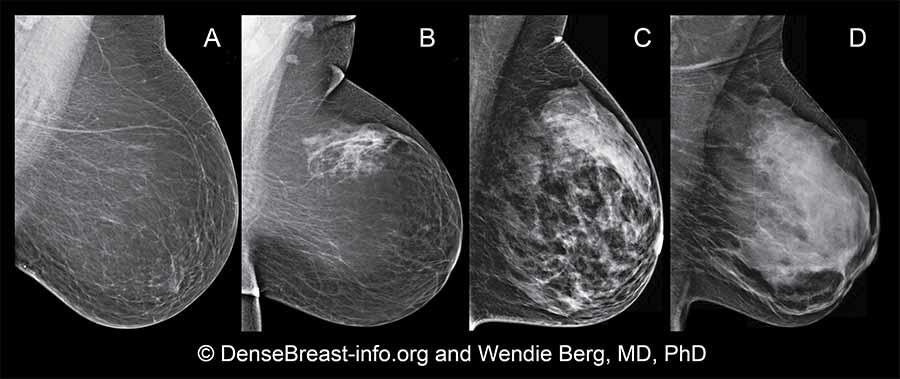
The four chest density categories are shown in this image. Breasts tin be most entirely fat (A), take scattered areas of dense fibroglandular breast tissue (B), take many areas of glandular and connective tissue (C), or be extremely dense (D). Breasts are classified equally "dumbo" if they fall in the heterogeneously dumbo (C) or extremely dense (D) categories.
Does having dense breast tissue bear upon a woman's mammogram?
Mammograms can be harder to read in women with dense breasts than in women with fat breasts. That'south because dense breast tissue and some abnormal breast changes, such equally calcifications and tumors, announced as white areas in the mammogram. As a result, mammography is less sensitive in women with dense breasts — that is, it is more likely to miss cancer. Women with dense breasts may exist chosen back for follow-upwardly tests more often than women with fatty breasts. Dense breasts can as well put women at higher risk of interval breast cancer. This is chest cancer that is diagnosed within 12 months of a normal mammogram result.
Are dense breasts a risk factor for breast cancer?
Yes, women with dense breasts take a higher take chances of breast cancer than women with fatty breasts, and the risk increases with increasing breast density. This increased risk is split from the consequence of dense breasts on the ability to read a mammogram.
Are breast cancer patients with dense breasts more likely to die from breast cancer?
No. Enquiry has institute that breast cancer patients who have dumbo breasts are no more likely to dice from breast cancer than breast cancer patients who have fat breasts, subsequently accounting for other health factors and tumor characteristics.
Should women with dense breasts have additional screening for breast cancer?
In some states, mammography providers are required to inform women who have a mammogram well-nigh chest density in full general or nigh whether they take dense breasts. Many states now require that women with dense breasts be covered past insurance for supplemental imaging tests. A Usa map showing data about specific state legislation is available from DenseBreast-info.org.
Nonetheless, the value of supplemental, or additional, screening tests such as ultrasound or MRI for women with dense breasts is not yet clear, according to the Concluding Recommendation Statement on Breast Cancer Screening by the United States Preventive Services Task Forcefulness. Ongoing clinical trials are evaluating the role of supplemental imaging tests in women with dense breasts. NCI'due south Cancer Data Service can tell you virtually clinical trials and provide tailored clinical trial searches to help you lot learn more than near clinical trials related to breast density and chest cancer screening.
Recent research has suggested that for women with dumbo breasts, a screening strategy that also takes into business relationship a woman'south adventure factors and protective factors may exist the best predictor of whether a adult female will develop chest cancer after a normal mammogram and before her next scheduled mammogram.
As you talk with your doctor about your personal risk for breast cancer, keep in mind that:
- adventure factors increase your chance of breast cancer
- protective factors lower your chance of breast cancer
NCI's PDQ® summary for Breast Cancer Prevention includes a section that lists risk factors and protective factors for breast cancer.
Information technology may help to ask your physician these questions, to put your risk for chest cancer into context:
- What are the findings of my recent mammogram?
- Are other additional screening or diagnostic tests recommended?
- What are my personal risk factors for breast cancer? Protective factors for breast cancer?
- What steps can I take to lower my adventure of breast cancer?
What are researchers hoping to larn about the relationship between breast density and breast cancer?
Some important questions include:
- Can imaging tests such equally three-D mammography (chest tomosynthesis), MRI, and ultrasound help provide a clearer picture of chest density?
- Are in that location certain patterns or areas of dense breast tissue that are specially "risky"?
- Why exercise some women with dense breasts become on to develop breast cancer, while others practice not? Tin can biomarkers be identified that help predict whether breast cancer will develop in a woman with dense breasts?
- Are changes in breast density over fourth dimension associated with changes in chest cancer risk?
- Tin women reduce their chest density, and potentially their breast cancer run a risk, by taking medicines or past applying topical agents directly to the chest?
NCI's Division of Cancer Prevention (DCP) supports research on cancer screening and gamble factors, including breast density, such as this clinical trial for women with dense breasts. NCI's Division of Cancer Epidemiology and Genetics (DCEG) conducts research on risk factors for cancer, as explained in this article that explores the relationship between mammographic breast density and breast cancer.
Source: https://www.cancer.gov/types/breast/breast-changes/dense-breasts
0 Response to "How Do You Know if Your Breasts Are Dense"
Post a Comment