Song Ray Charles I ll Take Her Back Again
| Ray Charles | |
|---|---|
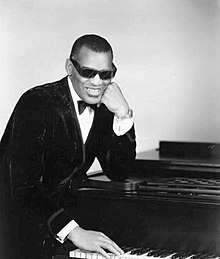 Charles in the 1960s | |
| Born | Ray Charles Robinson[note 1] (1930-09-23)September 23, 1930 Albany, Georgia, U.S.[1] |
| Died | June 10, 2004(2004-06-10) (aged 73) Beverly Hills, California, U.Southward. |
| Resting place | Inglewood Park Cemetery |
| Occupation |
|
| Years agile | 1947–2004[two] |
| Spouse(south) |
|
| Children | 12 |
| Musical career | |
| Genres |
|
| Instruments |
|
| Years agile | 1947–2004[2] |
| Labels |
|
| Associated acts |
|
| Website | raycharles |
Ray Charles Robinson Sr. [notation 1] (September 23, 1930 – June 10, 2004) was an American vocalist, songwriter, pianist, and composer. He is regarded as i of the most iconic and influential singers ever, and he was often referred to past contemporaries as "The Genius". Amidst friends and fellow musicians he preferred being called "Blood brother Ray".[three] [iv] Charles was blinded during babyhood, mayhap due to glaucoma.[2]
Charles pioneered the soul music genre during the 1950s by combining blues, jazz, rhythm and blues, and gospel styles into the music he recorded for Atlantic Records.[ii] [5] [6] He contributed to the integration of state music, rhythm and blues, and pop music during the 1960s with his crossover success on ABC Records, notably with his ii Modern Sounds albums.[7] [8] [nine] While he was with ABC, Charles became one of the kickoff black musicians to exist granted artistic command by a mainstream record company.[five]
Charles's 1960 hit "Georgia On My Mind" was the first of his iii career No. 1 hits on the Billboard Hot 100. His 1962 album Modern Sounds In Country And Western Music became his first anthology to top the Billboard 200.[10] Charles had multiple singles accomplish the Top xl on diverse Billboard charts: 44 on the Us R&B singles chart, 11 on the Hot 100 singles chart, 2 on the Hot Country singles charts.[11]
Charles cited Nat King Cole every bit a chief influence, but his music was likewise influenced by Louis Jordan and Charles Chocolate-brown.[12] He had a lifelong friendship and occasional partnership with Quincy Jones. Frank Sinatra called Ray Charles "the but true genius in show business," although Charles downplayed this notion.[thirteen] Billy Joel said, "This may sound like sacrilege, but I recollect Ray Charles was more important than Elvis Presley".[xiv]
For his musical contributions, Charles received the Kennedy Center Honors, the National Medal of Arts, and the Polar Music Prize. He was one of the inaugural inductees at the Stone and Roll Hall of Fame in 1986. He has won eighteen Grammy Awards (5 posthumously),[10] the Grammy Lifetime Achievement Honor in 1987, and 10 of his recordings have been inducted into the Grammy Hall of Fame.[10] Rolling Stone ranked Charles No. x on their list of the 100 Greatest Artists of All Fourth dimension,[3] and No. 2 on their list of the 100 Greatest Singers of All Time.[fifteen] In 2022, he was inducted into the Black Music & Amusement Walk of Fame.[sixteen]
Early life and education [edit]
Ray Charles Robinson was born on September 23, 1930, in Albany, Georgia.[note 1] He was the son of Bailey Robinson, a laborer, and Aretha (or Reatha) Robinson (née Williams), a laundress, of Greenville, Florida.
During Aretha's childhood her mother died. Her father could not keep her. Bailey, a man her male parent worked with, took her in. The Robinson family—Bailey, his wife Mary Jane and his mother— informally adopted her and Aretha took the surname Robinson. A few years later fifteen-yr-quondam Aretha became pregnant past Bailey. During the ensuing scandal, she left Greenville belatedly in the summer of 1930 to be with family unit in Albany, Georgia. After the birth of the kid, Ray Charles, she and the infant Charles returned to Greenville. Aretha and Bailey's wife, who had lost a son, and then shared in Charles'south upbringing. The father abandoned the family unit, left Greenville, and married another woman elsewhere. By his beginning birthday, Charles had a blood brother, George. Later, no one could remember who George'due south father was.[12]
Charles was deeply devoted to his female parent and afterward recalled, despite her poor health and arduousness, her perseverance, self-sufficiency, and pride as guiding lights in his life.
In his early years, Charles showed an interest in mechanical objects and would frequently watch his neighbors working on their cars and subcontract machinery. His musical curiosity was sparked at Wylie Pitman's Reddish Wing Buffet, at the historic period of three, when Pitman played boogie woogie on an quondam upright pianoforte; Pitman afterwards taught Charles how to play the piano. Charles and his mother were ever welcome at the Red Wing Cafe and fifty-fifty lived there when they were in fiscal distress.[12] Pitman would also care for Ray'south younger brother George, to take some of the burden off their mother. George accidentally drowned in his mother'due south laundry tub when he was four years old.[12] [17]
Charles started to lose his sight at the age of iv[4] or five,[18] and was blind past the historic period of seven, likely as a result of glaucoma.[19] Destitute, uneducated, and mourning the loss of her younger son, Aretha Robinson used her connections in the local customs to find a school that would accept a blind African-American pupil. Despite his initial protest, Charles attended school at the Florida School for the Deaf and the Blind in St. Augustine from 1937 to 1945.[12]
Charles further developed his musical talent at school[19] and was taught to play the classical piano music of Bach, Mozart and Beethoven. His teacher, Mrs. Lawrence, taught him how to use braille music, a difficult process that requires learning the left hand movements by reading braille with the right hand and learning the right hand movements by reading braille with the left hand, and so combining the 2 parts.
Ray Charles's mother died in the spring of 1945, when he was 14. Her death came every bit a shock to him; he later said the deaths of his blood brother and mother were "the two great tragedies" of his life. Charles decided not to render to school subsequently the funeral.[12]
Career [edit]
1945–1952: Florida, Los Angeles, and Seattle [edit]
Later leaving school, Charles moved to Jacksonville to live with Charles Wayne Powell, who had been friends with his late mother. He played the piano for bands at the Ritz Theatre in LaVilla for over a twelvemonth,[xx] earning $4 a night (US$41, in 2021 value[21]). He joined Local 632 of the musicians' union, in the hope that information technology would aid him get work,[22] and was able to employ the union hall'south piano to practice, since he did non have one at home; he at that place learned piano licks from copying the other players.[23] He started to build a reputation as a talented musician in Jacksonville, merely the jobs did non come up fast enough for him to construct a strong identity, then, at age xvi, he moved to Orlando, where he lived in borderline poverty and went without nutrient for days.[24] It was difficult for musicians to find work; since World War II had ended, there were no "M.I. Joes" left to entertain.[ commendation needed ] Charles eventually started to write arrangements for a pop music band, and in the summer of 1947, he unsuccessfully auditioned to play pianoforte for Lucky Millinder and his sixteen-piece band.[25]
In 1947, Charles moved to Tampa, where he held two jobs, including one as a pianist for Charles Brantley'south Love Dippers.[26]
In his early on career, Charles modeled himself on Nat King Cole. His first four recordings—"Wondering and Wondering", "Walking and Talking", "Why Did You Go?" and "I Found My Infant There"—were allegedly done in Tampa, although some discographies merits he recorded them in Miami in 1951 or else Los Angeles in 1952.[25]
Charles had e'er played piano for other people, but he was keen to have his own ring. He decided to leave Florida for a large city, and, considering Chicago and New York City as well big, followed his friend Gossie McKee to Seattle, Washington, in March 1948, knowing that the biggest radio hits came from northern cities.[25] [27] There he met and befriended, under the tutelage of Robert Blackwell, the xv-twelvemonth-old Quincy Jones.[28]
With Charles on piano, McKee on guitar, and Milton Garrett on bass, the McSon trio (named for Mc Kee and Robin son ) started playing the i–5 A.Grand. shift at the Rocking Chair.[29] Publicity photos of this trio are some of the primeval known photographs of Charles. In Apr 1949, he and his band recorded "Confession Blues", which became his kickoff national striking, soaring to the 2d spot on the Billboard R&B chart.[25] While notwithstanding working at the Rocking Chair, Charles besides arranged songs for other artists, including Cole Porter's "Ghost of a Chance" and Dizzy Gillespie's "Emanon".[24] After the success of his start two singles, Charles moved to Los Angeles in 1950 and spent the next few years touring with the blues musician Lowell Fulson every bit Fulson'south musical managing director.[4]
In 1950, Charles' performance in a Miami hotel impressed Henry Stone, who went on to record a Ray Charles Rockin' record, which did not achieve popularity. During his stay in Miami, Charles was required to stay in the segregated just thriving blackness customs of Overtown. Rock later on helped Jerry Wexler find Charles in Saint petersburg.[30]
Later on signing with Swing Time Records, Charles recorded ii more than R&B hits under the name Ray Charles: "Infant, Let Me Hold Your Hand" (1951), which reached No. 5, and "Kissa Me Baby" (1952), which reached No. 8. Swing Time folded the following year, and Ahmet Ertegun signed Charles to Atlantic.[nineteen]
In addition to beingness a musician, Charles was also a tape producer, producing Guitar Slim's number 1 striking, "The Things That I Used to Do".
1952–1959: Atlantic Records [edit]

In June 1952, Atlantic bought Charles's contract for $two,500 (United states of america$25,511 in 2021 dollars[21]).[31] [32] His first recording session for Atlantic ("The Midnight Hour"/"Roll with My Infant") took place in September 1952, although his last Swing Fourth dimension release ("Misery in My Heart"/"The Snow Is Falling") would not announced until February 1953.
In 1953, "Mess Around" became his first pocket-sized hit for Atlantic; during the next year, he had hits with "Information technology Should've Been Me" and "Don't Yous Know".[32] He besides recorded the songs "Midnight Hour" and "Sinner's Prayer" around this time.
Belatedly in 1954, Charles recorded "I've Got a Woman". The lyrics were written by bandleader Renald Richard. Charles claimed the composition. They later admitted that the song went back to the Southern Tones' "Information technology Must Be Jesus" (1954). It became one of his most notable hits, reaching No. two on the R&B chart.[32] "I've Got a Woman" combined gospel, jazz, and dejection elements. In 1955, he had hits with "This Petty Girl of Mine" and "A Fool for You". In upcoming years, hits included "Drown in My Ain Tears" and "Hallelujah I Dear Her So". In 1959, the vocal"What'd I Say" reached No. 6 on the Billboard Pop chart and No. one on the Billboard R&B chart.[11] [32]
Charles also recorded jazz, such as The Great Ray Charles (1957). He worked with vibraphonist Milt Jackson, releasing Soul Brothers in 1958 and Soul Meeting in 1961. Past 1958, he was not only headlining major black venues such every bit the Apollo Theater in New York, but besides larger venues such as Carnegie Hall and the Newport Jazz Festival, where his first alive album was recorded in 1958. He hired a female singing group, the Cookies, and renamed them the Raelettes. In 1958, Charles and the Raelettes performed for the famed Cavalcade of Jazz concert produced by Leon Hefflin Sr. held at the Shrine Auditorium on August 3. The other headliners were Petty Willie John, Sam Cooke, Ernie Freeman, and Bo Rhambo. Sammy Davis Jr. was besides there to crown the winner of the Miss Cavalcade of Jazz dazzler contest. The event featured the top four prominent disc jockeys of Los Angeles.[33] [34]
1959–1971: Crossover success [edit]
Charles reached the meridian of his success at Atlantic with the release of "What'd I Say", which combined gospel, jazz, dejection and Latin music. Charles said he wrote it spontaneously while he was performing in clubs with his ring. Despite some radio stations banning the song considering of its sexually suggestive lyrics, the vocal became Charles' starting time top-10 popular record.[35]
Afterward in 1959, he released his first land song (a cover of Hank Snow's "I'yard Movin' On") and recorded three more albums for the label: a jazz record (The Genius After Hours, 1961); a dejection record (The Genius Sings the Blues, 1961); and a large band record (The Genius of Ray Charles, 1959) which was his first Peak xl anthology, peaking at No. 17.[36]
His contract with Atlantic expired in 1959, and several big labels offered him record deals. Choosing not to renegotiate his contract with Atlantic, he signed with ABC-Paramount in November 1959.[37] He obtained a more liberal contract than other artists had at the time, with ABC offering him a $50,000 (Us$464,783 in 2021 dollars[21]) annual accelerate, higher royalties than before, and eventual ownership of his main tapes—a very valuable and lucrative deal at the fourth dimension.[38] During his Atlantic years, Charles had been hailed for his inventive compositions, simply by the time of the release of the largely instrumental jazz album Genius + Soul = Jazz (1960) for ABC's subsidiary label Impulse!, he had given upwardly on writing to follow his eclectic impulses every bit an interpreter.[35] [ clarification needed ]
With "Georgia on My Mind", his starting time hit unmarried for ABC-Paramount in 1960, Charles received national acclamation and 4 Grammy Awards, including two for "Georgia on My Listen" (Best Vocal Functioning Single Record or Track, Male, and All-time Functioning past a Pop Unmarried Artist). Written by Stuart Gorrell and Hoagy Carmichael, the song was Charles's get-go piece of work with Sid Feller, who produced, arranged and conducted the recording.[35] [39] Charles' rendition of the tune would aid drag it to the status of an American classic, and his version as well became the state song of Georgia later on in 1979.[forty] [41]
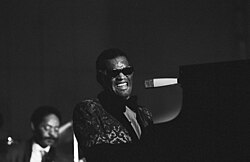
Charles earned another Grammy for the follow-up rail "Hitting the Road Jack", written past R&B singer Percy Mayfield.
Past tardily 1961, Charles had expanded his modest route ensemble to a big band, partly as a response to increasing royalties and touring fees, becoming ane of the few blackness artists to cross over into mainstream pop with such a level of creative control.[35] [42] This success, however, came to a momentary halt during a concert tour in November 1961, when a law search of Charles'south hotel room in Indianapolis, Indiana, led to the discovery of heroin in the medicine cabinet. The case was eventually dropped, as the search lacked a proper warrant past the police, and Charles presently returned to music.[42]
In the early 1960s, on the style from Louisiana to Oklahoma City, Charles faced a most-death experience when the pilot of his plane lost visibility, as snow and his failure to utilize the defroster caused the windshield of the airplane to become completely covered in ice. The pilot fabricated a few circles in the air before he was finally able to run across through a small function of the windshield and land the plane. Charles placed a spiritual interpretation on the experience, claiming that "something or someone which instruments cannot find" was responsible for creating the small opening in the ice on the windshield which enabled the pilot to eventually land the aeroplane safely.[12]
The 1962 anthology Mod Sounds in Country and Western Music and its sequel, Modern Sounds in Country and Western Music, Vol. ii, helped to bring state music into the musical mainstream. Charles's version of the Don Gibson song "I Can't Stop Loving You" topped the Pop chart for v weeks, stayed at No. one on the R&B chart for ten weeks, and gave him his only number-one record in the Uk. In 1962, he founded his tape label, Tangerine, which ABC-Paramount promoted and distributed.[12] : 248 [25] : 213–16 He had major pop hits in 1963 with "Busted" (US No. 4) and "Take These Chains from My Heart" (United states No. 8).[43] In 1964, Margie Hendrix was kicked out of the Raelettes later a large argument.
In 1964, Charles'south career was halted over again after he was arrested for a tertiary time for possession of heroin.[44] He agreed to get to a rehabilitative facility to avoid jail time and eventually kicked his habit at a clinic in Los Angeles. After spending a year on parole, Charles reappeared in the charts in 1966 with a serial of hits composed with Ashford & Simpson and Jo Armstead,[45] including the trip the light fantastic toe number "I Don't Need No Doctor" and "Let'south Go Get Stoned", which became his first number-1 R&B hitting in several years. His cover version of "Crying Fourth dimension", originally recorded by country singer Cadet Owens, reached No. 6 on the pop nautical chart and helped Charles win a Grammy Award the following March. In 1967, he had a superlative-20 hit with another carol, "Here We Go Again".[46]
1971–1983: Commercial decline [edit]

Charles'southward renewed nautical chart success, nonetheless, proved to be brusque lived, and by the 1970s his music was rarely played on radio stations. The rise of psychedelic stone and harder forms of stone and R&B music had reduced Charles's radio entreatment, as did his choosing to record pop standards and covers of contemporary rock and soul hits, since his earnings from owning his master tapes had taken away the motivation to write new material. Charles nevertheless connected to take an active recording career. Most of his recordings between 1968 and 1973 evoked potent reactions: either adored or panned past fans and critics alike.[19] His recordings during this catamenia, especially 1972's A Message from the People, moved toward the progressive soul sound pop at the time.[47] A Bulletin from the People included his unique gospel-influenced version of "America the Beautiful" and a number of protest songs about poverty and civil rights. Charles was often criticized for his version of "America the Beautiful" because it was very drastically changed from the song's original version. On July xiv, 1973, Margie Hendrix, the mother of Ray's son Charles Wayne Hendrix, died at 38 years former, which led to Ray caring for the child. The official cause of her expiry is unknown.
In 1974, Charles left ABC Records and recorded several albums on his ain label, Crossover Records. A 1975 recording of Stevie Wonder's hit "Living for the City" subsequently helped Charles win another Grammy. In 1977, he reunited with Ahmet Ertegun and re-signed to Atlantic Records, for which he recorded the album True to Life, remaining with his old characterization until 1980. Nevertheless, the label had at present begun to focus on rock acts, and some of their prominent soul artists, such as Aretha Franklin, were starting to be neglected. In November 1977 he appeared as the host of the NBC boob tube show Saturday Night Live.[48]
In April 1979, his version of "Georgia on My Mind" was proclaimed the state song of Georgia, and an emotional Charles performed the song on the flooring of the state legislature. In 1980 Charles performed in the musical moving picture The Dejection Brothers.[nineteen] Although he had notably supported the American Civil Rights Motility and Martin Luther King Jr. in the 1960s, Charles was criticized for performing at the Lord's day City resort in Due south Africa in 1981 during an international boycott protesting that country'due south apartheid policy. He later defended his option of performing in that location, insisting that the audience of blackness and white fans would integrate while he was there.[19]
1983–2004: Later years [edit]
In 1983, Charles signed a contract with Columbia. He recorded a cord of state albums and had striking singles in duets with singers such equally George Jones, Chet Atkins, B. J. Thomas, Mickey Gilley, Hank Williams Jr., Dee Dee Bridgewater ("Precious Matter") and his longtime friend Willie Nelson, with whom he recorded "Seven Spanish Angels".
In 1985, Charles participated in the musical recording and video "We Are the Earth", a charity single recorded by the supergroup United Support of Artists (USA) for Africa.

Earlier the release of his commencement anthology for Warner, Would You Believe, Charles made a return to the R&B charts with a cover of the Brothers Johnson's "I'll Be Good to You lot", a duet with his lifelong friend Quincy Jones and the singer Chaka Khan, which hitting number one on the R&B chart in 1990 and won Charles and Khan a Grammy for their duet. Prior to this, Charles returned to the popular charts with "Baby Thousand", a duet with the vocalizer Billy Joel. In 1989, he recorded a cover of the Southern All Stars' "Itoshi no Ellie" for a Japanese Boob tube advertisement for the Suntory brand, releasing it in Nippon as "Ellie My Love", where it reached No.3 on its Oricon chart.[49] In the same year he was a special invitee at the Arena di Verona during the bout promoting Oro Incenso & Birra of the Italian vocaliser Zucchero Fornaciari.
In 2001–02, Charles appeared in commercials for the New Jersey Lottery to promote its campaign "For every dream, there's a jackpot".[l]
In 2003, he headlined the White Business firm Correspondents Dinner in Washington, D.C., attended by President George Due west. Bush-league, Laura Bush, Colin Powell and Condoleezza Rice.[51]
Also in 2003, Charles presented Van Morrison with Morrison'south award upon beingness inducted in the Songwriters Hall of Fame, and the two sang Morrison'southward song "Crazy Dearest" (the performance appears on Morrison's 2007 anthology The All-time of Van Morrison Volume 3). In 2003, Charles performed "Georgia on My Mind" and "America the Beautiful" at a televised annual feast of electronic media journalists held in Washington, D.C. His final public appearance was on April thirty, 2004, at the dedication of his music studio as a historic landmark in Los Angeles.[19]
Legacy [edit]
Influence on music industry [edit]
Charles possessed one of the most recognizable voices in American music. In the words of musicologist Henry Pleasants:
Sinatra, and Bing Crosby before him, had been masters of words. Ray Charles is a master of sounds. His records disclose an extraordinary assortment of slurs, glides, turns, shrieks, wails, breaks, shouts, screams and hollers, all wonderfully controlled, disciplined past inspired musicianship, and harnessed to ingenious subtleties of harmony, dynamics and rhythm... It is either the singing of a man whose vocabulary is inadequate to limited what is in his center and mind or of one whose feelings are besides intense for satisfactory verbal or conventionally melodic articulation. He can't tell it to you lot. He tin can't fifty-fifty sing it to you. He has to cry out to yous, or shout to you, in tones eloquent of despair—or exaltation. The phonation alone, with piddling assistance from the text or the notated music, conveys the message.[52]

Pleasants continues, "Ray Charles is commonly described as a baritone, and his speaking voice would advise as much, every bit would the difficulty he experiences in reaching and sustaining the baritone'south high E and F in a popular carol. Simply the voice undergoes some sort of transfiguration nether stress, and in music of gospel or dejection grapheme he tin and does sing for measures on end in the loftier tenor range of A, B flat, B, C and even C sharp and D, sometimes in full voice, sometimes in an ecstatic head vocalisation, sometimes in falsetto. In falsetto he continues up to Eastward and F higher up high C. On one boggling record, 'I'yard Going Down to the River'...he hits an incredible B apartment...giving him an overall range, including the falsetto extension, of at to the lowest degree 3 octaves."
His manner and success in the genres of rhythm and dejection and jazz had an influence on a number of highly successful artists, including, as Jon Pareles has noted, Elvis Presley, Aretha Franklin, Stevie Wonder, Van Morrison, and Billy Joel.[53] Other singers who have acknowledged Charles'due south influence on their own styles include James Booker,[54] Steve Winwood,[55] Richard Manuel,[56] and Gregg Allman.[57] According to Joe Levy, a music editor for Rolling Rock, "The hit records he made for Atlantic in the mid-1950s mapped out everything that would happen to stone 'n' roll and soul music in the years that followed".[35] Charles was also an inspiration to Pinkish Floyd fellow member Roger Waters, who told the Turkish newspaper Hurriyet: "I was near 15. In the heart of the dark with friends, we were listening to jazz. It was "Georgia on My Mind", Ray Charles's version. Then I thought '1 day, if I make some people feel only one-twentieth of what I am feeling now, it will exist quite plenty for me.'"[58]
Ray, a biopic portraying his life and career between the mid-1930s and 1979, was released in October 2004, starring Jamie Foxx as Charles. Foxx won the 2005 Academy Award for Best Actor for the function.
Awards and honors [edit]
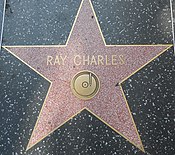
In 1975, Ray Charles was inducted into the American Academy of Achievement and presented with the Golden Plate Award and the Academy of Accomplishment gold medal.[59] [sixty]
In 1979, Charles was i of the first musicians born in the state to be inducted into the Georgia Music Hall of Fame.[61] His version of "Georgia on My Listen" was too fabricated the official country song of the land of Georgia.[62]
In 1981, he was given a star on the Hollywood Walk of Fame and was 1 of the first inductees to the Stone & Coil Hall of Fame at its countdown anniversary, in 1986.[63] He likewise received the Kennedy Heart Honors in 1986.[64]
Charles won 17 Grammy Awards from his 37 nominations.[x] In 1987, he was awarded the Grammy Lifetime Accomplishment Honor.[ten]
In 1991, he was inducted to the Rhythm & Blues Foundation and was presented with the George and Ira Gershwin Award for Lifetime Musical Achievement during the 1991 UCLA Spring Sing.[65]
In 1990, he was given an honorary doctorate of fine arts by the University of South Florida.[66]
In 1993, he was awarded the National Medal of Arts.[67] In 1998 he was awarded the Polar Music Prize, together with Ravi Shankar, in Stockholm, Sweden. In 2004 he was inducted to the National Blackness Sports & Entertainment Hall of Fame.[68] The Grammy Awards of 2005 were dedicated to Charles.
In 2001, Morehouse College honored Charles with the Candle Award for Lifetime Achievement in Arts and Entertainment,[69] and afterwards that same year granted him an honorary physician of humane letters.[70] Charles donated $2 million to Morehouse "to fund, educate and inspire the side by side generation of musical pioneers."[seventy]
In 2003, Charles was awarded an honorary caste by Dillard University, and upon his death he endowed a professorship of African-American culinary history at the school, the first such chair in the nation.[71]
In 2010, a $20 million, 76,000 sq ft (vii,100 one thousandtwo) facility named the Ray Charles Performing Arts Center and Music Bookish Building, opened at Morehouse.[72]
The United States Postal Service issued a forever stamp honoring Charles, as part of its Musical Icons series, on September 23, 2013.[73]
In 2015, Charles was inducted into the Rhythm and Blues Music Hall of Fame.[74]
In 2016, U.S. President Barack Obama said, "Ray Charles's version of "America the Beautiful" will always be in my view the most patriotic piece of music ever performed"[75]
In 2022, Charles was posthumously inducted into the Country Music Hall of Fame,[76] [77] the third African-American to be inducted after Charley Pride (2000) and Deford Bailey (2005). He was also the 13th person to be inducted into both the Country and Rock Halls of Fame.[78]
Contribution to civil rights movement [edit]
On March 15, 1961, shortly after the release of the hit song "Georgia on My Listen" (1960), the Albany, Georgia-built-in musician was scheduled to perform at a trip the light fantastic toe at Bell Auditorium in Augusta, but cancelled the show later learning from students of Paine College that the larger auditorium dance floor would be restricted to whites, while blacks would be obligated to sit in the Music Hall balcony. Charles left town immediately after letting the public know why he wouldn't be performing, but the promoter went on to sue Charles for breach of contract, and Charles was fined $757 in Fulton County Superior Court in Atlanta on June xiv, 1962. The following year, Charles did perform at a desegregated Bell Auditorium concert together with his backup group the Raelettes on Oct 23, 1963,[79] [80] [81] as depicted in the 2004 picture, Ray.[82] On December seven, 2007, Ray Charles Plaza was opened in Albany, Georgia, with a revolving, lighted bronze sculpture of Charles seated at a piano.[65]
The Ray Charles Foundation [edit]

Statue by Andy Davis in Ray Charles Plaza in Albany, Georgia
Founded in 1986, the Ray Charles Foundation maintains the mission statement of financially supporting institutions and organizations in the inquiry of hearing disorders.[83] Originally known as The Robinson Foundation for Hearing Disorders, it was renamed in 2006 and has provided financial donations to numerous institutions involved in hearing loss research and teaching.[84] The purpose of the foundation has been "to administer funds for scientific, educational and charitable purposes; to encourage, promote and educate, through grants to institutions and organizations, equally to the causes and cures for diseases and disabilities of the hearing dumb and to assist organizations and institutions in their social educational and academic advancement of programs for the youth, and conduct on other charitable and educational activities associated with these goals every bit allowed by police".[85]
Recipients of donations include Benedict College, Morehouse College, and other universities.[86] The foundation has taken action against donation recipients who do not employ funds in accord with its mission statement, such every bit the Albany State University, which was fabricated to render a $3 meg donation after not using the funds for over a decade.[87] The foundation houses its executive offices at the historic RPM International Building, originally the home of Ray Charles Enterprises and now also home to the Ray Charles Memorial Library on the kickoff flooring, which was founded on September 23, 2010 (what would have been his 80th birthday). The library was founded to "provide an artery for young children to experience music and art in a manner that volition inspire their creativity and imagination", and is not open to the public without reservation, as the main goal is to educate mass groups of underprivileged youth and provide art and history to those without access to such documents.[88]
Personal life [edit]
Charles stated in his 1978 autobiography, Brother Ray: Ray Charles' Own Story, that he became hooked on women after losing his virginity at 12 years quondam to a adult female about 20. "Cigarettes and smack [heroin] are the two truly addictive habits I've known. You lot might add women," he said. "My obsession centers on women—did then [when young] and does now. I can't go out them solitary," he added.[89]
Relationships and children [edit]
Charles was married twice. His start marriage was less than a yr, his 2nd 22 years. Throughout his life Charles had many relationships with women with whom he fathered a dozen children.
His marriage to Eileen Williams lasted from July 31, 1951, until 1952.
He met his 2nd wife Della Beatrice Howard Robinson (called "Bea" by Charles) in Texas in 1954. They married the following year on April five, 1955. Their first child together, Ray Charles Robinson Jr., was born in 1955. Charles was non in town for the nativity considering he was playing a bear witness in Texas. The couple had ii more sons, David and Robert. They raised their children in View Park, California.[90] Charles felt that his heroin habit took a toll on Della during their matrimony.[12] Due to his drug habit, extramarital affairs on tours and volatile behavior, the wedlock deteriorated and they divorced after 22 years of union in 1977.[91]
Charles had a six-year-long affair with Margie Hendrix, one of the original Raelettes, and in 1959 they had a son, Charles Wayne. His affair with Mae Mosley Lyles resulted in another daughter, Renee, born in 1961. In 1963, by Sandra Jean Betts, Ray Charles had a daughter, Sheila Raye Charles, a singer and songwriter who died of breast cancer on June xv, 2017.[92] In 1977, Charles had a child with his Parisian lover Arlette Kotchounian whom he met in 1967.[93] His long-term girlfriend and partner at the time of his death was Norma Pinella.[94]
Charles fathered a total of 12 children with ten different women:[36]
- Evelyn Robinson, born in 1949 (daughter with Louise Flowers)
- Ray Charles Robinson Jr., built-in May 25, 1955 (son with married woman Della Bea Robinson)
- David Robinson, born in 1958 (son with married woman Della Bea Robinson)
- Charles Wayne Hendricks, born on October 1, 1959 (son with Margie Hendricks, 1 of the Raelettes)[93]
- Robert Robinson, born in 1960 (son with wife Della Bea Robinson)
- Renee Robinson, born in 1961 (daughter with Mae Mosely Lyles)
- Sheila Robinson, born in 1963 (girl with Sandra Jean Betts)
- Reatha Butler, born in 1966
- Alexandra Bertrand, born in 1968 (daughter with Mary-Chantal Bertrand)
- Vincent Kotchounian, built-in in 1977 (son with Arlette Kotchounian)
- Robyn Moffett, born in 1978 (daughter with Gloria Moffett)
- Ryan Corey Robinson den Bok, born in 1987 (son with Mary Anne den Bok)[91]
Charles held a family tiffin for his twelve children in 2002, ten of whom attended. He told them he was mortally ill and $500,000 had been placed in trusts for each of the children to be paid out over the next v years.[36] [95]
Drug abuse and legal issues [edit]
At eighteen, Charles first tried marijuana when he played in McSon Trio and was eager to attempt it every bit he thought it helped musicians create music and tap into their creativity. He later became fond to heroin for seventeen years.[89] Charles was first arrested in 1955, when he and his bandmates were caught backstage with loose marijuana and drug paraphernalia, including a burnt spoon, syringe, and needle. The arrest did not deter his drug use, which only escalated as he became more successful and made more money.[25]
In 1958, Charles was arrested on a Harlem street corner for possession of narcotics and equipment for administering heroin.[96]
Charles was arrested on a narcotics charge on Nov fourteen, 1961, while waiting in an Indiana hotel room before a performance. The detectives seized heroin, marijuana, and other items.[97] Charles, then 31, said he had been a drug addict since the age of 16. The case was dismissed because of the fashion in which the evidence was obtained,[98] but Charles' situation did non improve until a few years later on.
On Halloween 1964, Charles was arrested for possession of heroin at Boston'due south Logan Airport.[44] He decided to quit heroin and entered St. Francis Infirmary in Lynwood, California, where he endured 4 days of cold turkey withdrawal. Following his self-imposed stay, he pleaded guilty to four narcotic charges. Prosecutors called for two years in prison and a hefty fine, but the judge listened to Charles' psychiatrist, Dr. Hacker's account of Charles' conclusion to get off drugs and he was sent to McLean Hospital in Belmont, Massachusetts.[99] The judge offered to postpone the verdict for a year if Charles agreed to undergo regular examinations past government-appointed physicians. When Charles returned to court, he received a five-year suspended sentence, four years of probation, and a fine of $10,000.[100]
Charles responded to the saga of his drug use and reform with the songs "I Don't Need No Doctor" and "Allow's Go Get Stoned" and the release of Crying Fourth dimension, his starting time album since kicking his heroin addiction in 1966.[101] [102]
Chess hobby [edit]
Charles enjoyed playing chess. As part of his therapy when he quit heroin, he met with psychiatrist Friedrich Hacker, who taught him how to play chess, three times a calendar week.[100] He used a special board with raised squares and holes for the pieces. When questioned if people endeavour to cheat against a blind man, he joked in reply, "You lot can't cheat in Chess... I'g gonna meet that!"[103] In a 1991 concert, he referred to Willie Nelson as "my chess partner".[104] In 2002, he played and lost to the American grandmaster and former U.Due south. champion Larry Evans.[105]
Expiry [edit]
In 2003, Charles had successful hip replacement surgery and was planning to go back on bout, until he began having other ailments. He died at his home in Beverly Hills, California, of complications resulting from liver failure,[4] on June 10, 2004, at the age of 73.[106] His funeral took place on June 18, 2004, at the Beginning African Methodist Episcopal Church of Los Angeles, with numerous musical figures in attendance.[107] B.B. Male monarch, Glen Campbell, Stevie Wonder and Wynton Marsalis each played a tribute at the funeral.[108] He was interred in the Inglewood Park Cemetery.
His final album, Genius Loves Company, released two months afterward his expiry, consists of duets with admirers and contemporaries: B.B. Male monarch, Van Morrison, Willie Nelson, James Taylor, Gladys Knight, Michael McDonald, Natalie Cole, Elton John, Bonnie Raitt, Diana Krall, Norah Jones and Johnny Mathis. The album won viii Grammy Awards, including All-time Pop Vocal Album, Album of the Year, Record of the Yr and Best Pop Collaboration with Vocals (for "Here Nosotros Go Again", with Norah Jones), and Best Gospel Functioning (for "Heaven Help Us All", with Gladys Knight); he also received nods for his duets with Elton John and B.B. King. The album included a version of Harold Arlen and E. Y. Harburg's "Over the Rainbow", sung as a duet with Johnny Mathis, which was played at Charles' memorial service.[108]
The episode "School's Out: The Musical" from The Fairly OddParents was defended to his retentivity.
Discography [edit]
Charles' discography is highly circuitous and all-encompassing. AllMusic has listed approximately 60 original albums and more than than 200 compilation albums, while music essayist Robert Christgau noted the existence of more. At least twenty tape labels accept released near-identical compilations of Charles' pre-Atlantic Records tracks, while many of the masters that Charles began to own after 1960 were non digitally reissued, leading the Atlantic sis label Rhino Entertainment to focus on rereleasing his mid-to-late 1950s music. Christgau has called Charles' discography a "monumental mess" and that "any map of his oeuvre must be personal and provisional".[109]
Filmography [edit]
Moving-picture show [edit]
| Year | Title | Function | Notes |
|---|---|---|---|
| 1961 | Swingin' Along | Himself | |
| 1965 | Ballad in Bluish | Himself | |
| 1966 | The Big T.N.T. Bear witness | Himself | Documentary picture |
| 1980 | The Blues Brothers | Ray | Cameo advent |
| 1989 | Limit Up | Julius | |
| 1990 | Listen Up: The Lives of Quincy Jones | Himself | Documentary |
| 1994 | Love Affair | Himself | Cameo appearance |
| 1996 | Spy Hard | Bus Commuter | Cameo appearance |
| 1998 | New Yorkers two | Himself | Cameo appearance |
| 2000 | The Extreme Adventures of Super Dave | Himself | |
| 2000 | Bluish'due south Big Musical Movie | M-Clef (voice) | Final picture show role before his decease in 2004 |
| 2004 | Ray | Himself | Uncredited Archival footage |
| 2014 | Confront of Unity | Himself | https://www.imdb.com/championship/tt3612316/plotsummary includes tributes to Nelson Mandela from President Barack Obama, Sam Jackson, Ray Charles, Morgan Freeman. |
Tv set [edit]
| Year | Championship | Role | Notes |
|---|---|---|---|
| 1977 | Saturday Night Live | Himself (host) | Season three, Episode 5 |
| 1977- | Sesame Street | Himself | 3 episodes |
| 1987 | Who'due south the Boss | Himself | Episode: "Hit the Route, Chad" |
| 1987 | St. Elsewhere | Arthur Tibbits | Episode: "Jose, Can You See?" |
| 1987 | Moonlighting | Himself | Episode: "A Trip to the Moon" |
| 1987-1990 | Super Dave | Himself | 4 episodes |
| 1994 | Ray Alexander: A Sense of taste for Justice | Idiot box movie | |
| 1994 | Wings | Himself | Episode: "A Decent Proposal" |
| 1997–1998 | The Nanny | Sammy | four episodes |
See also [edit]
- Album era
- Progressive soul
Notes [edit]
- ^ a b c According to Eagle, Bob 50.; LeBlanc, Eric S. (May 2013). Blues: A Regional Feel. p. 361. ISBN9780313344244. , based on the authors' interpretation of 1935 Florida census data, he was born Horace Charles Robinson in Greenville, Florida. However, about other reliable sources give his birth name every bit Ray Charles Robinson, and his birthplace every bit Albany, Georgia. It has been suggested that there has been a misinterpretation and that Horace Charles Robinson was in fact a half-brother.[ citation needed ]
References [edit]
- ^ "Biography". raycharles.com. Archived from the original on Oct 12, 2007. Retrieved 2013-09-22 .
{{cite web}}: CS1 maint: bot: original URL condition unknown (link) - ^ a b c d Unterberger, Richie. "Ray Charles". AllMusic. Retrieved 2019-12-xx .
- ^ a b Morrison, Van. "100 Greatest Artists of All Fourth dimension. No.ten: Ray Charles". Rolling Stone . Retrieved June thirteen, 2010.
- ^ a b c d "Ray Charles, American Legend, Dies at 73". NPR.org. June 11, 2004. Retrieved September 25, 2014.
- ^ a b Hoye, Jacob, ed. (2003). 100 Greatest Albums. Simon and Schuster. p. 210. ISBN978-0-7434-4876-5.
- ^ "Prove 15: The Soul Reformation". digital.library.unt.edu . Retrieved 15 December 2018.
- ^ Guide Profile: Ray Charles, About.com; retrieved December 12, 2008.
- ^ Palmer, Robert (February 9, 1978). "Soul Survivor Ray Charles". Rolling Stone (258): 10–14. Archived from the original on March 1, 2010. Retrieved November 9, 2008.
- ^ Tyrangiel, Josh (2006). "Review: Modern Sounds in Country and Western Music". Time. Archived from the original on February xviii, 2007. Retrieved July 21, 2009.
- ^ a b c d e "Ray Charles". Recording Academy Grammy Awards. 23 November 2020.
- ^ a b "Ray Charles Chart History". Billboard.
- ^ a b c d east f g h i Charles, Ray; Ritz, David (1992). Brother Ray. New York: Da Capo Press. ISBN0-306-80482-4.
- ^ Bronson, Fred (1997). The Billboard Volume of Number One Hits (4th ed.). New York: Watson-Guptill. p. 98. ISBN0-8230-7641-five.
- ^ "A Tribute to Ray Charles". Rolling Stone, nos. 952–953, July 8–22, 2004.
- ^ Joel, Billy. "100 Greatest Singers of All Time. No.2: Ray Charles". Rolling Stone . Retrieved June 13, 2010.
- ^ Nazareno, Mia (2021-12-17). "Smokey Robinson, Berry Gordy, Jr. & More to Exist Inducted at 2022 Black Music and Entertainment Walk of Fame". Billboard . Retrieved 2021-12-27 .
- ^ Parker, Jeff. "Ray Charles Biography". www.swingmusic.net . Retrieved 16 December 2018.
- ^ Leung, Rebecca (October 14, 2004). "The Genius of Ray Charles: hour Looks Dorsum at the Life and Loves of a True Original" (about a 1986 segment on Charles from lx Minutes).
- ^ a b c d due east f 1000 Graham, Eamon (2004). "Obituary: Ray Charles (1930–2004)". Bohème Mag.
- ^ Remembering Ray Charles' Northeast Florida Roots - The Littoral
- ^ a b c 1634–1699: McCusker, J. J. (1997). How Much Is That in Existent Money? A Historical Price Index for Use every bit a Deflator of Coin Values in the Economic system of the United states of america: Addenda et Corrigenda (PDF). American Antiquarian Lodge. 1700–1799: McCusker, J. J. (1992). How Much Is That in Real Money? A Historical Toll Alphabetize for Use every bit a Deflator of Money Values in the Economy of the Us (PDF). American Antiquarian Society. 1800–present: Federal Reserve Banking company of Minneapolis. "Consumer Price Index (estimate) 1800–". Retrieved April xvi, 2022.
- ^ Winski, Norman (1994). Ray Charles. Holloway Firm Publishing. p. 102. ISBN9780870677908.
- ^ Winski, Norman (1994). Ray Charles. Holloway Firm Publishing. p. 104. ISBN9780870677908.
- ^ a b Winski, Norman (1994). Ray Charles: Vocaliser and Musician. Los Angeles: Melrose Square Publishing. pp. 102–107. ISBN0-87067-790-Ten.
- ^ a b c d e f Lydon, Michael (1998). Ray Charles: Man and Music . Riverhead Books. ISBN1-57322-132-5.
- ^ "Charlie Brantley and His Original Dear Dippers". Tampabaymusichistory.com. Retrieved 2017-01-sixteen .
- ^ "Charles, Ray (1930–2004)". HistoryLink.org.
- ^ "Quincy Jones Biography". Achievement.org. Archived from the original on September 26, 2012. Retrieved December 22, 2014.
- ^ Ford, Carin T. (2007). Ray Charles: "I was Born with Music Inside Me". Enslow Publishers, Inc. ISBN978-0766027015.
- ^ Katel, Jacob (November 22, 2012). "Henry Stone: Legendary Soul". Miami New Times . Retrieved February 14, 2013.
- ^ Fricke, David (Apr 26, 2001). "The Story of Atlantic Records: Ahmet Ertegun in His Own Words". Rolling Stone.
- ^ a b c d Szatmary, David P. (2014). Rockin' in Fourth dimension. Pearson. p. 177.
- ^ Guralnick, Peter. (2005). Dream boogie : the triumph of Sam Cooke (1st ed.). New York: Petty, Chocolate-brown. ISBN0316377945. OCLC 57393650.
- ^ "Applause! In the Theatre" Review by Hazel L. Lamarre Los Angeles Spotter July 24, 1958
- ^ a b c d e Pareles, Jon; Weinraub, Bernard (June 11, 2004). "Ray Charles, Bluesy Essence of Soul, Is Dead at 73". The New York Times . Retrieved December 12, 2008.
- ^ a b c Pennington, Karlton (2013). Ray Charles. Lulu Press, Inc. ISBN9781304151254.
- ^ Ray Charles, "I Tin can't Cease Loving Y'all". Kalamu.com. Retrieved Baronial xiii, 2008.
- ^ "RS Biography: Ray Charles 1930-2004". Rolling Stone. Archived from the original on October 12, 2007. Retrieved August 14, 2008.
- ^ The RS 500 Greatest Songs of All Time: 44) "Georgia on My Heed". Rolling Stone.com; retrieved Baronial 14, 2008.
- ^ "29 Blackness Music Milestones: Ray Charles' 'Georgia' Becomes State Vocal". Billboard. 2011-02-12. Retrieved 2022-03-31 .
- ^ Gioia, Ted (2021). The jazz standards : a guide to the repertoire (Second ed.). New York. ISBN978-0-19-008717-3. OCLC 1238128525.
- ^ a b Cooper (1998), pp. xx–22.
- ^ "Ray Charles Chart History". Billboard . Retrieved March 16, 2018.
- ^ a b Bordowitz, Hank (Baronial 24, 2015). "Saving Ray Charles - Super Lawyers Massachusetts". Super Lawyers . Retrieved 2019-xi-18 .
- ^ Wikane, Christian John (September xi, 2017). "The Brill Building, Broadway, and Across: R&B and Soul Vocalizer-songwriter Joshie Armstead". PopMatters.
- ^ "Ray Charles Profile". PianoFiles.com. Archived from the original on May four, 2014. Retrieved April 11, 2015.
- ^ Swenson, John, ed. (1999). The Rolling Stone Jazz & Blues Album Guide. Random House. p. 138. ISBN9780679768739.
- ^ "Ray Charles". SnlTranscripts.jt.org. November 12, 1977. Retrieved September x, 2010.
- ^ "Listing of Best-Selling International Singles in Nihon of 1989". Oricon. Wbs.ne.jp. Archived from the original on 2007-01-03. Retrieved March one, 2018.
- ^ Zammit, Deanna (Feb 4, 2003). "N.J. Lottery Is in Play". Adweek . Retrieved 26 Nov 2018.
- ^ "2003 White House Correspondents' Dinner Entertainment". C-span.org. Retrieved March 4, 2017.
- ^ Pleasants, Henry (1974). The Great American Popular Singers. New York City: Simon and Schuster. ISBN9780671216818.
- ^ Pareles, Jon. "Ray Charles, Who Reshaped American Music, Dies at 73". The New York Times . Retrieved September 23, 2018.
- ^ Russell, Tony (1997). The Dejection: From Robert Johnson to Robert Cray. Dubai: Carlton Books. p. 94. ISBN1-85868-255-X.
- ^ Buckley, Michael. "A Chat With Steve Winwood: June 10, 2005". The Annapolis Capital. Retrieved September 23, 2018.
- ^ Viney, Peter. "Influences on The Band: Ray Charles". theband.hiof.no. Retrieved September 23, 2018.
- ^ Lynskey, John (5 December 2016). "Gregg Allman Alive: Back to Macon". greggallman.com. Retrieved September 23, 2018.
- ^ Oskay, Cinar. "Roger Waters, Cinar Oskay roportaji: 'Muziginizin hatirlanmasi sizin icin onemli mi?'". Hurriyet (in Turkish). Retrieved August 4, 2013.
- ^ "Aureate Plate Awardees of the American University of Achievement". www.accomplishment.org. American Academy of Accomplishment.
- ^ "Photo: 2 University members, William J. Clinton, 42nd President of the United States, and Ray Charles at the 2003 Banquet of the Golden Plate Accolade gala ceremonies". American Academy of Accomplishment.
- ^ "List of Inductees". Georgia Music Hall of Fame. 1979–2007. Archived from the original on Oct fifteen, 2006. Retrieved November 25, 2006.
- ^ "State Vocal". Georgia Secretary of State. 1979.
- ^ "Inductees". Rock and Roll Hall of Fame & Museum. Archived from the original on November 23, 2006. Retrieved November 25, 2006.
- ^ "List of Kennedy Center Honorees". Kennedy Heart. 1986. Retrieved November 25, 2006.
- ^ a b "Calendar & Events: Spring Sing: Gershwin Award". UCLA. Retrieved April xi, 2015.
- ^ "Jet". 28 May 1990. p. 22. Retrieved 25 Oct 2018 – via Google Books.
- ^ "Lifetime Honors—National Medal of Arts". Nea.gov. Archived from the original on July 21, 2011. Retrieved September 10, 2010.
- ^ "Hall of Fame". National Black Sports & Entertainment. 2004. Archived from the original on March 9, 2007. Retrieved November 25, 2006.
- ^ "Morehouse College Bennie and Candle Recipients 1989–2013". Morehouse College. 2013. Archived from the original on 2017-03-17. Retrieved March 16, 2017.
- ^ a b "Ray Charles Performing Arts Eye". Raycharles.com. 2015. Retrieved March 16, 2017.
- ^ Read, Mimi (February 23, 2005). "A Souvenir to Black Cuisine, from Ray Charles". The New York Times . Retrieved October eleven, 2010.
- ^ Seymour, Add, Jr. (September 29, 2010). "Morehouse Cuts the Ribbon on the Ray Charles Performing Arts Center and Music Academic Building" (Press release). Morehouse College. Archived from the original on 17 March 2017. Retrieved March 16, 2017.
- ^ Ray Charles US Stamp Gallery
- ^ "R&B Music Hall of Fame Comes to Detroit". wdet.org . Retrieved half dozen Nov 2018.
- ^ Quoted in David Remnick (2016), "Soul Survivor: The Revival and Subconscious Treasure of Aretha Franklin". The New Yorker. April four, 2016. Retrieved on April 4, 2016.
- ^ Kristin Chiliad. Hall, AP Entertainment Writer (May 1, 2022). "The Judds, Ray Charles join the Country Music Hall of Fame". ABC News. Retrieved May 1, 2022.
- ^ Williams, Chris (May one, 2022). "Judds Inducted Into Country Hall of Fame in Tearful Ceremony a Day After Naomi's Death". Multifariousness. ;
- ^ Hall, Kristin Yard. (August 16, 2021). "Ray Charles, The Judds to join Land Music Hall of Fame". The Seattle Times. Associated Press. Retrieved August 23, 2021.
{{cite web}}: CS1 maint: url-status (link) - ^ "William B. Bong Auditorium". augustaciviccenter.com . Retrieved June eight, 2012.
- ^ Rhodes, Don (July ane, 2004). "Ray Charles gave land music his own bear on". The Augusta Chronicle.
- ^ Fontenot, Robert. "How did racism touch on Ray Charles?". about.com . Retrieved June nine, 2012.
- ^ "32 Years Ago This Month: Ray Charles Serenades the Legislature". AtlantaMagazine.com. Archived from the original on March eleven, 2013. Retrieved January 18, 2013.
- ^ "Mission Statement". Theraycharlesfoundation.org. Archived from the original on 2015-02-22. Retrieved December 21, 2014.
- ^ "Bridegroom College receives $500,000 gift?". Benedict.edu. Archived from the original on 2014-10-16. Retrieved Dec 21, 2014.
- ^ "Well-nigh the Foundation". Theraycharlesfoundation.org. Archived from the original on 2015-02-22. Retrieved December 21, 2014.
- ^ "Morehouse Gets $3 Million Souvenir from Ray Charles Foundation". Ajc.com. Retrieved June 8, 2021.
- ^ "Ray Charles Foundation wants $iii million gift back from Albany Country Academy - NY Daily News". New York Daily News. 15 February 2012. Retrieved 16 December 2018.
- ^ "Well-nigh the Library". Theraycharlesfoundation.org. Archived from the original on October 6, 2014. Retrieved December 21, 2014.
- ^ a b "Ray Charles' Ain Book Reveals He". Jet. Vol. 55, no. 11. Nov 30, 1978. pp. 22–24, sixty–62.
- ^ Robinson, Louie (October 1974). "The Indelible Genius of Ray Charles". Ebony: 132.
- ^ a b "Della Beatrice Howard Robinson". NewSwirl. December 30, 2017.
- ^ "The girl of Music Icon Ray Charles; Sheila Raye Charles succumbs to breast cancer". Einpresswire.com. 2017-06-xv. Retrieved 2017-06-25 . [ unreliable source? ].
- ^ a b Evans, Mike (2009). Ray Charles: Nativity of Soul. London: Coach. ISBN9780857120519.
- ^ Whitaker, Matthew (2011). Icons of Blackness America: Breaking Barriers and Crossing Boundaries [3 volumes]: Breaking Barriers and Crossing Boundaries [Three Volumes]. ABC-CLIO. ISBN9780313376436.
- ^ "Ray Charles' children battle over his legacy". Los Angeles Times. 2008-04-20. Retrieved 2020-06-02 .
- ^ "Vocalizer Ray Charles Jailed on Dope Charge". Jet. Vol. 15, no. five. December iv, 1958. p. 57.
- ^ "Ray Charles Nabbed On Dope Charge, Wants To 'Take Cure'". Jet: 58–59. November 30, 1961.
- ^ "Prove sixteen – The Soul Reformation". unt.edu. Academy of Due north Texas. Retrieved September 18, 2010.
- ^ Turner, G.A. (January 6, 2002). "More than than Merely a Glory Psych Ward". Hartford Courant . Retrieved 3 February 2019.
- ^ a b Schinder, Scott; Schwartz, Andy (2007). Icons of Stone: An Encyclopedia of the Legends Who Changed Music Forever. ABC-CLIO. p. 44. ISBN9780313338458.
- ^ "Ray Charles: Lessons From His Life & Death". BlackDoctor.org . Retrieved March 16, 2017.
- ^ "Most Ray Charles". PBS.org. May 17, 2006. Retrieved March 16, 2017.
- ^ "The chess games of Ray Charles". Chessgames.com. Archived from the original on October 7, 2014. Retrieved December 22, 2014.
- ^ Charles, Ray (2005). Genius & Friends (CD). Burbank, California: Atlantic Records. Event occurs at Track 13 ii:22.
- ^ "Chess News – GM Larry Melvyn Evans (1932–2010)". ChessBase.com. Retrieved December 30, 2011.
- ^ D'Angelo, Joe. "Ray Charles Dead at 73". mtv.com . Retrieved January 1, 2012.
- ^ "Little Richard Has Middle Set on". Stcatharinesstandard.ca. Archived from the original on February 1, 2014. Retrieved April 25, 2014.
- ^ a b "Many Pay Respects to Ray Charles". CBS News. June 10, 2004. Retrieved November 25, 2006.
- ^ Christgau, Robert (July eight, 2004). "The Genius at Work: Ray Charles, A Critical Discography". Rolling Stone . Retrieved July 24, 2021 – via robertchristgau.com.
External links [edit]
- Ray Charles Married woman wiki
- Official website
- Daily Telegraph obituary
- Oral history video excerpts at the National Visionary Leadership Project
- Land Music Hall of Fame
- Appearance at WFOY Radio edifice
- Ray Charles autobiography: The Early on Years 1930–1960 at the Wayback Automobile (archived October 12, 2007)
- Appearances on C-SPAN
- Ray Charles discography at Discogs
- Ray Charles at Observe a Grave
- Ray Charles at IMDb
- Ray Charles discography at MusicBrainz
- "Ray Charles". Rock and Ringlet Hall of Fame.
- Ray Charles at Rolling Stone

Source: https://en.wikipedia.org/wiki/Ray_Charles
0 Response to "Song Ray Charles I ll Take Her Back Again"
Post a Comment